Contextual Collaboration Within Freshservice Projects via Slack
Here's introducing Slack+Freshservice projects—where your team can have conversations and contextually collaborate on all IT projects from a single tool of their choice.


The latest News and Information on IT Service Management, Service Desk and related technologies.
The ultimate aim for all businesses is to deliver superlative customer service and earn goodwill in customer relationship management (CRM). And field service management is an extremely crucial part of CRM, and field service market is growing its demand from USD 3.0 billion in 2020 to USD 5.1 billion by 2025 (Markets and Markets). For many organizations across different industry verticals, field service plays a vital role in achieving customer satisfaction objectives and aids business expansion.
Founded in 1896, healthcare company Roche has innovation in its DNA. When you’re in the business of creating new medicine and diagnostic tests for millions of patients across the world, innovation can transform lives. My role is in our people and culture (P&C) team. For the past number of years, we’ve been looking for more agile, human-centric ways to improve collaboration and, ultimately, the patient and employee experience.
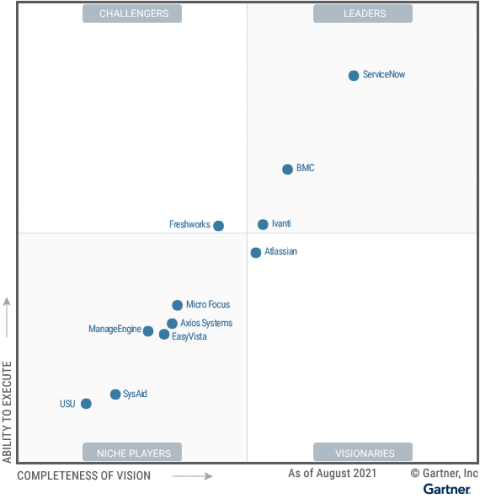
ManageEngine has been named a Niche Player in the 2021 Gartner® Magic Quadrant™ for IT Service Management Tools. This is the second consecutive year that ManageEngine has been positioned in the Magic Quadrant.
Within the initial blog in this series, we discussed ransomware attacks and their remediation on Android mobile devices. Part 2 addresses potential ransomware exploits and their remediation on iOS, iPadOS mobile devices and macOS desktops.
Mean time to innocence (MTTI) is a term used by IT teams to prove that their respective domain is not the source of a particular issue. In other words, it’s a fancy term to avoid blame when something goes wrong. Each team has its own domain-specific tools to prove the issue is not their fault. With respect to desktop virtualization, here are just some of the domains that are relevant when diagnosing issues.
5G technology promises user benefits that include faster network speeds, better remote access to networks, more seamless videoconferencing, and more robust network security. These are all necessities for the new world of work, and many are eager to embrace them. The technology also offers advantages to telecommunications companies: Despite those benefits, many telecom providers continue to struggle with legacy processes.
When using Microsoft 365 services the main benefit of having a monitoring tool that can assess performance quality and identify issues is that it sends alerts into a ticketing tool such as ServiceNow for example, to initiate the process of remediating the problem. When you don’t have a monitoring tool in place then support tickets aren’t automatically sent and users must identify issues and send in tickets manually with little to no information on where the problem came from.