Operations | Monitoring | ITSM | DevOps | Cloud

3 ways to maximize efficiency with hyperautomation

Efficiency is the bedrock of success for any organization. In the continuous pursuit of streamlined operations and increased productivity, ServiceNow Automation Engine serves as a valuable asset, enabling ServiceNow platform owners and automation leaders to quickly and cost-effectively connect or automate any system, document, or task with minimal code.

Unlocking Network Capacity Monitoring & Planning: From Overload to Overdrive

In the world of networking, where connectivity and data flow are at the heart of operations, a network hiccup can spell disaster. The digital transformation wave has engulfed businesses of all sizes, and as companies become increasingly reliant on their networks to serve customers, collaborate with teams, and manage critical processes, the demand for robust and efficient network performance has never been higher.

How AIOps modernizes CMDBs to drive accuracy and value

Maintaining your Configuration Management Database’s (CMDB) accuracy, keeping it fully updated, and improving its performance is a frustrating and elusive goal for ITOps and IT leaders. Aiming for this ‘golden’ CMDB standard can feel like running on a treadmill where you’re putting in a lot of work, but remain as distant as ever from your goal. Can IT leaders ever catch up?

Ensuring consistent Kubernetes container versions

One of Kubernetes' killer features is its ability to seamlessly update applications no matter how large your deployment is. Did a developer make a code change, and now you need to update a thousand running containers? Just run kubectl apply -f manifest.yaml and watch as Kubernetes replaces each outdated pod with the new version.

How California's New Emissions Disclosure Law Will Affect Data Centers

The new law, SB 253, aims to bring more transparency and accountability to the public about how big businesses contribute to climate change. It also hopes to encourage companies to reduce their emissions and align with the state’s ambitious climate goals. By 2030, California plans to lower its greenhouse gas emissions by 40% below what they were in 1990.

Continuous integration for Yii2 APIs with Codeception

Continuous integration (CI) is the process of integrating changes from multiple contributors to create a single software project. A key component for a smooth CI pipeline is testing. Tests prove that the code does exactly what it says on the tin and that it’s safe to merge the code into the central repository. Tests also anticipate edge cases and ensure that the code handles such cases in a deterministic manner.

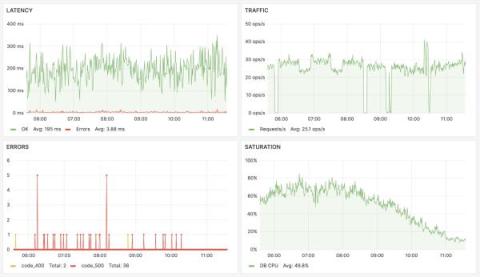
Debugging Modern Applications: Advanced Techniques

Today’s applications are designed to be always available and serve users 24/7. Performing live debugging on such applications is akin to doctors operating on a patient. Since the advent of the “as a service” model, software is like a living, breathing entity, akin to an anatomical system. Operating on such entities requires more dexterity on the developer’s part, to ensure that the software application lives on while being debugged and improved continuously.

Grafana Agent v0.37: Feature parity between Static and Flow mode, easy migration configs, and more

Grafana Agent v0.37 is here! This new release brings a lot of exciting new features and marks the pinnacle of a year-long effort to achieve feature parity between Grafana Agent Flow mode and Grafana Agent Static mode. We also extended our config converter to ease the migration from Static to Flow mode and we added the possibility to split your Flow configuration into multiple files. Please make note of some breaking changes in this release.

How to embed Grafana dashboards into web applications

Grafana dashboards are powerful and flexible tools for observing applications and infrastructure, so it’s no surprise we get a lot of questions from the community about how to embed them into their web applications. Over the past few releases, we’ve developed a lot of options for how to do this in Grafana, but there can be confusion about how they work, and when to use each approach.

The Path to a Dark NOC: Actionable Initiatives to Achieve Full Autonomy

A Dark Network Operations Center (NOC) is one that runs with no IT staff … at least that’s how it’s been defined up until now. But there’s more to interpret. Large, complex networks rely on the NOC — the core of network infrastructure — to keep them healthy and resilient. The NOC’s function allows employees, customers, partners, and other network users to rest a bit easier, and its integrity and accuracy gives them peace of mind.