Operations | Monitoring | ITSM | DevOps | Cloud

The latest News and Information on Monitoring for Websites, Applications, APIs, Infrastructure, and other technologies.

How to Get Stronger Consistency Out of a Datastore

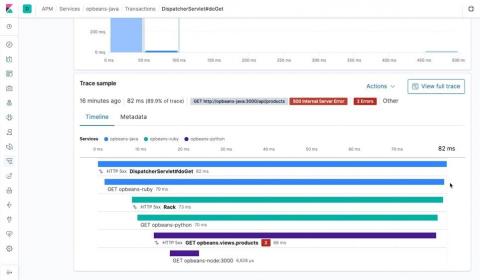
Welcome to our series of blog posts about things Sentry does that perhaps we shouldn’t do. Don’t get us wrong — we don’t regret our decisions. We’re sharing our notes in case you also choose the path less traveled. In this post, we stretch technologies to their limits to see real-time data while handling traffic spikes.

Have it Your Way - Detailing the New ServiceNow CMDB Release and Auto Balanced Collectors

Earlier this year we announced the official LogicMonitor - ServiceNow CMDB App, and it’s been exciting to see how quickly our customers are adopting the feature-rich integration. As with most workflow integrations across the LogicMonitor ecosystem, the CMDB App was built with customization in mind.

Icinga Module for AWS

Some say you have to move all of your server infrastructure into the cloud. Others counter that you should keep your data safe and secure in your own datacenter. And then there are many people in between who use cloud services as an addition to their self-hosted servers. In fact, there’s no right or wrong, because as always in IT: It depends. We at Icinga always try to find a way to make everyone happy with their monitoring – be it in the cloud or on premise.

12 Reasons to Opt for Serverless Computing for Your Mid-sized Venture

Serverless has become something of a buzzword lately - but it’s much more than a trend. Its benefits have gained the attention of professionals and amateurs in the tech industry, mainly due to how much cloud vendors have raved about the design. For mid-sized ventures, the idea of serverless is exceptionally appealing, for those looking for budget-friendly, but useful pieces of technology. It’s genuinely breaking the ground and is sure to make even more moves in the tech industry.

What Enterprise IT Teams Can Learn from Google Cloud's June Outage: A Guide

The following first appeared in Cloud Tech News. In early June 2019, Google Cloud suffered a cascading set of faults that rendered multiple service regions unavailable for a number of hours. This by itself isn’t totally unprecedented; what made it significant was the way it propagated through the very software that was designed to contain it. Moreover, engineers’ initial attempts to correct the issue were thwarted by the failure of that same software architecture.

What Is Network Agility and Why Does It Matter?

In a 2019 Top Trends Transforming Network Operations survey, 34% of networking pros identified improving network agility as their top business goal for the year. The stat isn’t surprising. “Network agility” is considered the future of networking, but the term itself has become a bit of a buzzword. Everyone’s talking about it, but no one can agree on its definition. So what does network agility actually mean? We surfed the web and analyzed what (almost) everyone has to say.

Challenges of Monitoring and Troubleshooting in Kubernetes Environments

Kubernetes is great but complex! Whether to enable hybrid and multi-cloud, promote deeper specialization among development teams, enhance reliability, or simply stay ahead of the curve, organizations are reaping the varied benefits of this technology investment— but it comes at a cost. With each optimization, there are tradeoffs. With each layer of abstraction comes less visibility, resulting in more complexity when something goes wrong.

How to Prepare Your Staff for Hybrid Cloud

By Des Nnochiri Budgetary constraints are often a key factor in determining how an organization sets up its IT infrastructure. The hybrid cloud typically leads to cost savings of between 5% and 30% for enterprises that make the transition. Besides the monetary aspects, performance benefits and easier administration also inspire many organizations to consider moving to a hybrid cloud.

From Homegrown to Hosted: How The Trade Desk Migrated to a Modern Monitoring System with Grafana Cloud

When Patrick O’Brien interviewed to become a Site Reliability Engineer at The Trade Desk™, it was clear that taking the company’s monitoring system to the next level was the priority. “A chunk of my interview was about The Trade Desk’s previous monitoring system and how to scale it,” says O’Brien, who joined The Trade Desk more than two years ago. “I had a good feeling that would be an early task.”