Operations | Monitoring | ITSM | DevOps | Cloud

The Technologies Shaping the Future of Work

Work is changing fast. The old nine-to-five grind feels outdated. People want flexibility. They want meaning. They want to avoid soul-crushing repetition. Technology drives this shift. New tools handle the boring stuff. They connect teams across continents. They make work more human, not less. The future workplace looks different than anyone predicted. It is more collaborative. It is more creative. It is powered by smart machines that amplify human potential. This transformation is already happening. Here is what it looks like.

Is Machine Learning Helping People Access Legal Support?

Machine learning describes a branch of artificial intelligence that lets computers learn from data and make choices without a human needing to write exact rules or steps. Instead, it uses data and patterns to improve itself over time. Machine learning has proved helpful in many industries by predicting trends and automating complex tasks, including healthcare, finance, and manufacturing. It may also be valuable for people seeking legal help in the following ways.

GPU monitoring in OpManager: Full visibility for every AI workload

AI has moved to be a core part of enterprise infrastructure. GPUs are the engines behind that shift. Every training run, every inference request, and every fine-tuning job depends on GPU chipsets that are expensive and delicate. A GPU that overheats, runs out of memory, or sits idle for hours doesn't just slow a project down, it quietly drains the IT budget. Most monitoring tools weren't built with this hardware in mind. This leaves AI and DevOps teams blindsided when a job fails or a chipset degrades.

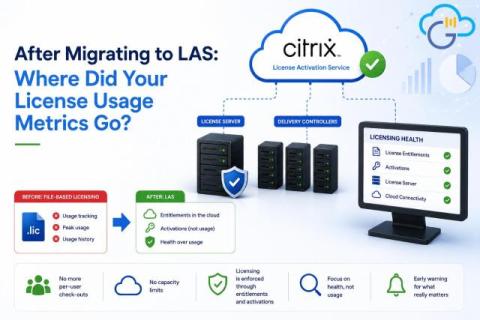
LAS Migration Aftermath: What Happened to Your License Usage Metrics?

When Citrix introduced License Activation Service (LAS), customers transitioned from the traditional file-based licensing model to a new cloud-connected licensing architecture. For most administrators, the migration itself was straightforward. The biggest surprise came afterwards, when familiar licensing metrics such as licenses in use, licenses available, and peak license usage disappeared from the Citrix License Server. The answer is no.

Choose a group when adding monitors

We’re making it easier to organize your monitors from the moment you add them. Previously, clicking Add would immediately add a monitor to your board. If your board already contained one or more groups, new monitors were automatically placed in the Ungrouped section, requiring an extra step to move them into the correct group. Now, clicking Add opens a list of your monitor groups, allowing you to choose exactly where the monitor should be added.

Safely Troubleshooting Customer Production Incidents Using MCP and AI Skills

See how Qovery's MCP server and AI skills turn vague production incidents into evidence-backed diagnoses while keeping engineers in control. Guillaume is a Staff Solutions Architect at Qovery. He helps customers troubleshoot production infrastructure and writes about Kubernetes operations, AI agents, and reliable cloud platforms.

Governance Starts at the Network: How We Put AI Agents in Production

AI agents are becoming a new persona in the org chart. Learn how Qovery enforces data control, limited access, and auditability at the network level. Romain is a staff engineer at Qovery working on the control plane and AI integrations. He writes about distributed systems, incident response, and MCP-based tooling.

Introducing AI Platform Traffic Visibility in Kentik

Generative AI has quickly emerged as a distinct over-the-top (OTT) traffic category, yet service providers have lacked the visibility to track it. Kentik now identifies traffic from 35+ AI services across 28 providers, showing operators how it enters their networks, where it’s growing, and what it costs to deliver.

Agent Guard: Control AI Assets Before They Become Shadow AI

A developer on your team just told Claude Code to connect to a new MCP server, the protocol coding agents use to reach organizational tools and data. Nobody in security reviewed it. Nobody in security even knows it happened. For two-thirds of enterprises, the primary obstacle to scaling agentic development isn’t budget or headcount — it’s security risk.