Operations | Monitoring | ITSM | DevOps | Cloud

The latest News and Information on APIs, Mobile, AI, Machine Learning, IoT, Open Source and more!

Just ask AI to add OpenTelemetry to your code

OpenTelemetry instrumentation used to mean hours of manual work, wiring up metrics service by service. Now you can just ask for it. Tell an AI agent what you're trying to observe, something like "add OpenTelemetry so I can track this application's performance," and it turns that into an intent specification, then enriches your existing code with instrumentation to match. OpenTelemetry is open source and on GitHub. Pairing it with an AI agent that actually understands your codebase is what turns "add some metrics" into instrumentation that's useful.

AI SAST Explained: Why Traditional Application Security Is Reaching Its Breaking Point | Harness Blog

AI has fundamentally changed software development. Developers are writing more code than ever. AI coding assistants can generate features, tests, documentation, and infrastructure configurations in minutes. Engineering organizations are seeing meaningful productivity gains as AI becomes embedded throughout the software development lifecycle. But there is a catch. Security teams now face a difficult reality: application security was already struggling to keep pace with software delivery before AI arrived.

Chaos Hub in docs, Prompt Library for MCP: what's new in Resilience Testing | Harness Blog

The latest Resilience Testing documentation update brings Chaos Hub directly into the docs, making it easier to discover and use fault, probe, and action templates. It also introduces a Prompt Library with ready-to-use AI prompts for Harness MCP, helping teams run resilience workflows faster using natural language.

The Industrial Mobile Browser Built for Supply Chain Work

Warehouse workers don’t think about whether their mobile interface runs on a browser. They’re focused on getting the job done. But for operations and IT teams evaluating or upgrading mobile technology in supply chain environments, platform choice matters more than most people realize. Consumer mobile browsers such as Safari, Edge and Chrome are useful tools designed for everyday web use. They help people search, shop, read, collaborate and access web applications from almost anywhere.

Open 360 AI's chat is now powered by OrionIQ

OrionIQ’s agentic investigation is now built into Logz.io Open 360 AI. Ask a question and OrionIQ investigates across your telemetry, shows its work as it goes, links every finding back to the exact query behind it, and tells you how much to trust the answer. Today we’re bringing OrionIQ Chat into Open 360 AI. This is the first OrionIQ product to ship inside the Logz.io platform, and it’s the same agent that powers the standalone OrionIQ app, now available right where you already work.

How to measure AI ROI: metrics and a framework finance can actually run

To measure AI ROI, compare attributable value (revenue lift, cost savings, engineering time recovered, risk reduction) against fully loaded AI spend (API usage, subscriptions, infrastructure, people time) at the unit level: per initiative, per team, per task. The formula is simple. The instrumentation is the hard part, and it's where most organizations are failing: in CloudZero's 2026 survey, 34% of finance leaders couldn't produce a credible ROI number at all.

NVIDIA B300 vs. NVIDIA B200: Blackwell Ultra vs. Blackwell

The Blackwell architecture arrived in 2024 as NVIDIA's answer to the next era of AI compute. The B200 set a new standard for inference performance, memory capacity, and training throughput, and many teams are still ramping up their use of it today. Then came Blackwell Ultra. The B300 is built on the same silicon foundation as the B200: same dual-reticle die design, same TSMC 4NP process node, same NVLink 5 interconnect.

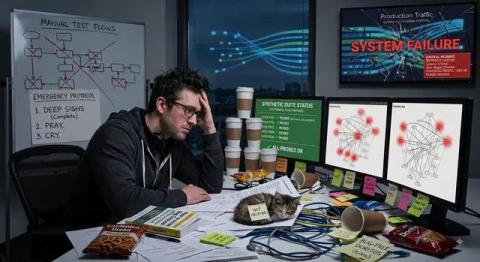
From Claude Code to Production: A Monitoring Checklist for Python Developers

Python is the native language of AI-assisted development. Models are really good at writing it, and a lot of people are now shipping it without ever having written much Python themselves. The whole thing is really simple. You prompt an app, Claude Code or Cursor produces a working Flask or FastAPI backend, and you’re live in a few hours. However, there’s still a big difference between “it works on my machine” and “it works in production”.

The Secret Sauce of SLSA: DevGovOps at the Speed of Agentic AI

Software supply chain engineering has reached a critical inflection point. As autonomous AI coding agents transition from generating autocomplete suggestions to planning, writing, reviewing, and deploying entire software pipelines without humans in the loop, the connection between human intent and production binaries is fracturing.