Operations | Monitoring | ITSM | DevOps | Cloud

Latest posts

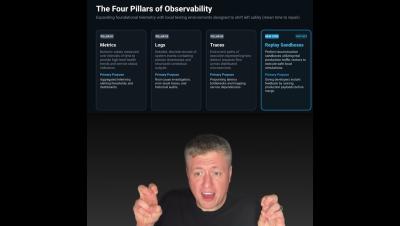
AI is Exposing Observability's Dirty Secret

The 3 pillars of observability are breaking. For years, dev teams relied on Logs, Metrics, and Traces to know when something went wrong. But now? AI agents are writing, deploying, and changing code in real-time. When an AI hallucination pushes a bug to production, standard monitoring sees nothing wrong.To survive the AI era, we need a 4th Pillar of Observability. Watch to find out what it is and why the old way of monitoring just became obsolete.

Why colocation is becoming the foundation of sovereign AI

The last few years have seen AI conversations dominated by the need for investment in hyperscale infrastructure as firms race to build ever larger training models. But as those conversations evolve, the emphasis is shifting to the next phase of AI adoption, focusing on the scaling of use cases and real-world value. In line with this shift, organisations are looking beyond where AI is trained to the specifics of where it is actually used.

Why the U.S. Locked Down Fable and Mythos: AI, National Security, and the Workforce Squeeze

The U.S. just barred foreign nationals from accessing two advanced AI models — Fable and Mythos — citing national security. Around the same time, the Five Eyes intelligence alliance warned that AI-enabled cyberattacks are "months, not years" away. In Season 5 of ShipTalk, host Adam and co-host Martin dig into whether that warning is already overdue — and what it means for the people actually defending software.

The rise of dark code and the death of architectural intent

As Staff Engineers and Principal Architects, most of us have spent years thinking about long-term system health. We are considerate of the company’s business objectives and strategy, accumulation of technical debt, and operational risk. For us it is not about whether code works today, but whether the engineer who inherits it in three years will be able to understand what it was trying to do and why. That's what makes a codebase maintainable rather than just functional.

What is AI cost observability? A guide to tracking LLM and AI spend

AI cost observability is the practice of measuring, attributing, and analyzing AI workload costs at the request, model, and workflow level in real time. It connects cloud infrastructure spend, inference and token costs, and business attribution (cost per feature, team, customer, or product) so engineering, finance, and product teams can see where AI spend goes and whether it creates value.

Enterprises are making their biggest AI bets blind

AI cost observability is the practice of measuring, attributing, and analyzing AI workload costs at the request, model, and workflow level in real time. It connects cloud infrastructure spend, inference and token costs, and business attribution (cost per feature, team, customer, or product) so engineering, finance, and product teams can see where AI spend goes and whether it creates value. On July 14, IBM had its worst trading day since 1987.