Mailchimp
Not subscribed to OpsMatters Newsletter


To put it bluntly, did someone die? In engineering, let’s hope your answer is a resounding no. So why do we continue to use the word ‘postmortem’?
Chaos Engineering is one of the hottest new approaches in DevOps. Netflix first pioneered it back in 2008, and since then it’s been adopted by thousands of companies, from the biggest names in tech to small software companies. In our age of highly distributed cloud-based systems, Chaos Engineering promotes resilient system architectures by applying scientific principles. In this article, I’ll explain exactly what Chaos Engineering is and how you can make it work for your team.
Every Java developer should follow coding standards and best practices to develop secure Java code. It is critical your code is not vulnerable to exploits or malicious attacks. In recent times, even big organizations like eBay, the CIA, and the IRS have fallen victim to vulnerabilities in their applications that have been discovered and exploited by attackers. The following guidelines provide a solid foundation for writing secure Java code and applications.
The Internet of Things (IoT) has quickly become a huge part of how people live, communicate and do business. All kinds of everyday things make up this network – fridges, kettles, light switches – you name it. If it’s connected to WiFi, it’s part of the Internet of Things. IoT raises significant challenges that could stand in your way of fully realizing its potential benefits.
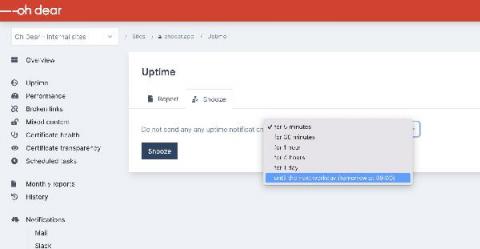
When a site is down, Oh Dear sends a notification every hour. Since last year, our notifications can be snoozed for a fixed amount of time (5 minutes, 1 hour, 4 hours, one day). In the evenings and weekends, you might not want to receive repeated notifications. That's why we've added a nice human touch: all notifications can now be snoozed until the start of the next workday. You can choose this new options in the snooze settings of a check.
In the present fast-moving digital world, it has become critical for businesses to measure and track their service delivery performance especially the incident management metrics that monitor the uptime of systems, downtime due to outages, and how fast and efficiently issues are resolved because even a slight glitch in the system can cause disruption in the business processes costing millions of dollars.
As Kubernetes adoption continues to grow, Kubernetes audit logs are a critical information source to incorporate in your Kubernetes security strategy. It allows security and DevOps teams to have full visibility into all events happening inside the cluster. The Kubernetes audit logging feature was introduced in Kubernetes 1.11.