Operations | Monitoring | ITSM | DevOps | Cloud

Kepler: Coordinate Every AI Coding Agent From One Place

Kepler is GitKraken's new agentic development environment (ADE), and it's now in public preview for Windows, Mac, and Linux. If GitKraken Desktop is built to go deep on one repository, Kepler is built to go wide: one task, multiple repositories, multiple AI agents, tracked in a single place instead of a dozen open terminals.
What build-versus-buy actually looks like in agentic engineering

Most build-versus-buy debates assume you're choosing once, at the start, and living with it. Agentic engineering doesn't work that way. The decision shows up at every layer of the stack, and the teams getting it right aren't the ones who picked "build" or "buy" as a philosophy. They're the ones who know which layer is which.

From retrieval to agents: 5 takeaways on production architecture for AI agents

How context engineering creates production-ready agentic AI What if the AI strategy you spent the past year building is already being measured by a completely different set of rules? I recently joined Amy Machado, senior research manager at IDC and Jim Malone, senior contributing editor at CIO Marketing Services, for a webinar where we explored how buyer expectations, architectural requirements, and evaluation criteria are shifting as enterprises move from search-driven experiences to agentic AI.

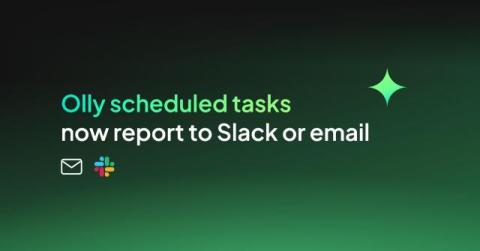
Olly says Hi: Scheduled tasks now report to Slack and email

An agent that only speaks when spoken to is a tool you have to remember to use. Olly has run on a schedule for a while now, working a saved prompt hourly, daily, weekly, or monthly and writing its findings into a chat with its own run history. Those scheduled tasks are now wired into the Coralogix Notification Center, so Olly delivers that output itself, allowing Olly to reach out to Slack or email, out of the box.

Workspace now reads your tickets and automates the fix

IT teams don’t need another place to look for problems. They need a faster way to understand what is happening, decide what to do next, and act before disruption spreads. That has always been the promise of Workspace. It gives IT teams a conversational way to investigate issues, surface insights from Nexthink data, and understand what needs attention across the digital workplace. Now, Workspace is entering its next phase.

Your Framework Doesn't Have to Be on Our List: How MCP Server Deployment Changes Everything

To deploy an application we haven't seen before, we need two things out of its repository. One is a Dockerfile that builds it. The other is a service definition saying what runs, which ports it listens on, which databases it needs, and what environment variables it expects. Customers arrive with a git URL, and we figure out the rest. We even do the tricky task of generating a Dockerfile if it doesn't already exist in the codebase. We've built a solution for this twice already.

Debug AI agents wherever they run, from Slack bots to code review with Sentry's Agent Tracing

Agent Tracing shows the full execution path of an AI agent: the model call, every tool invocation and its arguments, token counts, cost, and the span where it broke. Same traces and spans you already use, with agent-specific attributes on top. Serge walks through three apps — a Next.js e-commerce agent using the AI SDK with a failing tool call, a Slack bot built with Eve that orders lunch, and a code review agent built with Flue over MCP.

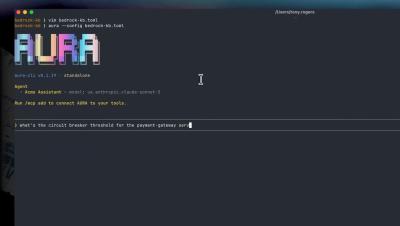
Run an AI SRE Agent Entirely Inside AWS with Bedrock and S3: AURA

An on-call question returns the threshold and the escalation owner from your own runbooks, and the answer comes back without a call to anyone outside. AURA runs against Bedrock as its model provider, using Claude Sonnet 5 served by AWS in the same region. Authentication is the normal AWS credential chain: a profile on a laptop, an IAM role in EKS.