Operations | Monitoring | ITSM | DevOps | Cloud

The latest News and Information on DevOps, CI/CD, Automation and related technologies.

Incident Response Team: Roles, Responsibilities, and Structure Explained

Incidents don’t wait. They hit production, disrupt users, and pull teams into long recovery cycles. And a well-structured incident response team helps you move fast, limit damage, and restore services without chaos. In this blog, we’ll explain what an incident response team is, its key functions, team composition, and different types of teams. Let’s get started!


7 Common Incident Response Challenges and How to Overcome Them

Incident response teams deal with several challenges. Alert noise, unclear ownership, lack of automation, and more. It’s important to keep an eye on these challenges and resolve them from time to time because they can turn minor issues into major outages. In this blog, we’ll discuss some of the common incident response challenges, how they affect, and how you can resolve them. Let’s dive in!

Incident Postmortem: How to Learn From Failures and Build Reliable Systems

When the issue settles, and systems are back, one question always remains: What actually happened, and how do we stop it from happening again? That’s where incident postmortems come in. Not just as documentation, but as a structured way to learn, improve reliability, and replace guessing with clarity. A good postmortem isn’t about blame, heroics, or perfect narratives. It’s about truth, learning, and building systems that get stronger with every failure.

Caching in C#: A Comprehensive Technical Guide

In.NET systems, performance is often won or lost on the read path. Every extra database or API call adds latency and cost. Caching fixes that by keeping frequently used data, like product lists or lookups, close to your code, turning slow trips into instant reads. This is not theoretical, it works in the real world. Stack Overflow runs a two-tier cache (in-process + Redis), where a Redis hop takes only 0.2–0.5 ms and local memory reads are effectively instant.

How to Connect Salesforce to Tableau and Use Near-Real-Time Data Across Teams

The effectiveness of Tableau Salesforce integration depends on one decisive factor: the connector. While Tableau’s native connector is straightforward and offers quick access, it lacks support for complex joins, uses scheduled extracts for refreshes, and doesn’t extend to other BI or ETL platforms. To overcome these constraints, many organizations implement ODBC Drivers, which deliver SQL depth and governance designed for analytics at scale.

(AusBiz) | How to Stay Secure in an AI-Driven Software World | The Last Call

In an era of AI-powered development, how do teams move fast and stay secure? JFrog SVP APAC, Sunny Rao, joined AusBiz’s The Last Call to break it down — from securing the software supply chain to why end-to-end visibility is now essential for every tech organization. Discover why this matters for the future of software and AI-driven innovation.

How generative AI solves healthcare's 1% carbon footprint

The healthcare industry accounts for 1% of the global carbon footprint, and a single PET CT scan can generate 60kg of CO₂! Regent Lee, Professor at the University of Oxford and moonshot engineer, reveals how Civo-powered Generative AI is transforming radiology. His team's solution eliminates pharmaceutical contrast injections, digitally displacing the pollution. This technology makes radiology safer, more efficient, and significantly greener for the environment. Sustainability in healthcare is non-negotiable.

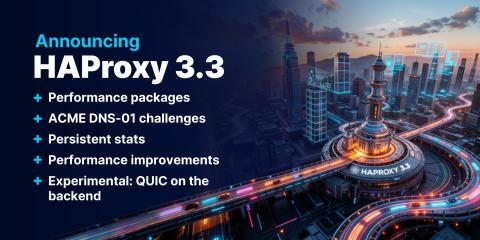
Announcing HAProxy 3.3

HAProxy 3.3 is here, and this release brings downloadable packages compiled by HAProxy Technologies, numerous TLS enhancements including expanded ACME support, better observability with persistent stats over reloads, and many improvements to performance and flexibility such as support for QUIC on the backend. These powerful capabilities help HAProxy remain the G2 category leader in API Management, Container Networking, DDoS Protection, Web Application Firewall (WAF), and Load Balancing.

Defend Against Shai-Hulud 2.0 Supply Chain Attack with Harness SCS

Shai-Hulud 2.0 shows how quickly a compromised maintainer account can result in thousands of infected NPM packages and repositories within hours. Harness SCS provides end-to-end SBOM visibility, policy enforcement to block compromised NPM packages, and complete traceability to detect malicious components early and prevent them from entering your pipelines.

From Concept to Reality: The Journey Behind Harness Database DevOps

Harness Database DevOps was born from a simple question - how can database delivery be as seamless and safe as application delivery? Through deep collaboration with design partners, open-source learnings, and relentless iteration, the team built a platform that unites developers, DBAs, and DevOps under a single, automated workflow. At its core, it’s a story of empathy-driven engineering - transforming database change management into a faster, more reliable, and collaborative experience.