Prometheus Remote Storage
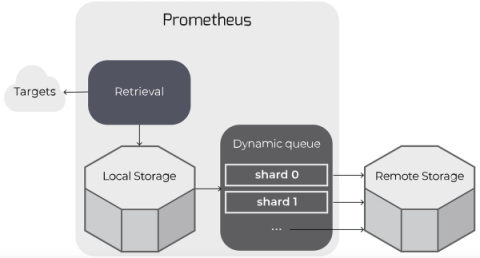
Prometheus can be configured to read from and write to remote storage, in addition to its local time series database. This is intended to support long-term storage of monitoring data.


Prometheus can be configured to read from and write to remote storage, in addition to its local time series database. This is intended to support long-term storage of monitoring data.
Collecting metrics about your servers, applications, and traffic is a critical part of an application development project. There are many things that can go wrong in production systems, and collecting and organizing data can help you pinpoint bottlenecks and problems in your infrastructure. In this article, we will discuss Graphite and StatsD, and how they can help form the basis of monitoring infrastructure.
Grafana is an open-source visualization and analytics tool that lets you query, graph, and alert on your time series metrics no matter where they are stored - Grafana dashboards provide telling insight into your organization. All data from Grafana Dashboards can be queried and presented with different types of panels ranging from time-series graphs and single stats displays to histograms, heat maps, and many more.
Grafana is an open-source platform for metric analytics, monitoring, and visualization. In this article, we will explore the basics of Grafana and learn how to deploy it to Kubernetes. You will find specific coding examples and screenshots you can follow to deploy Grafana.
Traditional logging tools are struggling to keep up with the explosive pace of data growth. Data collection isn’t the most straightforward process — so deploying and configuring all the tools necessary to manage this growth is more difficult than ever, and navigating evolving logging and monitoring requirements only adds another layer of complexity to the situation.
In today’s fast-paced, digital-first landscape, delivering exceptional customer experience is paramount to business success. For customer service teams, that means maintaining service level agreements (SLAs) and ensuring swift responses to customer issues that can make or break your company’s reputation. Fortunately, PagerDuty has improved the way companies handle customer service teams and has built applications into ServiceNow’s CSM platform.
Mean Time Between Failures (MTBF) measures the average duration between repairable failures of a system or product. MTBF helps us anticipate how likely a system, application or service will fail within a specific period or how often a particular type of failure may occur. In short, MTBF is a vital incident metric that indicates product or service availability (i.e. uptime) and reliability.
DX Unified Infrastructure Management (DX UIM) is a powerful solution that enables comprehensive infrastructure observability across your digital ecosystems, including private, public, and hybrid clouds. With DX UIM, you can proactively and efficiently manage the performance and availability of your IT infrastructure and applications. DX UIM 20.4 is the current main branch of the solution. This release offers a number of significant capabilities that weren’t available in earlier versions.
If you’ve ever found yourself juggling multiple code versions and branches, desperately needing a toolkit to keep things organized, you’re in good company. We understand the challenges of version control, and that’s where these Git clients for Mac come into play.
In our last blog, we talked about the importance of setting memory requests when deploying applications to Kubernetes. We explained how memory requests lets you specify how much memory (RAM for short) Kubernetes should reserve for a pod before deploying it. However, this only helps your pod get deployed. What happens when your pod is running and gradually consumes more RAM over time?