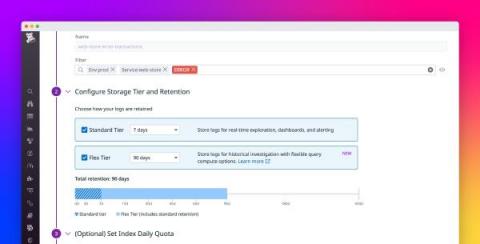
This year at DASH, we announced new products and features that enable your teams to get complete visibility into their AI ecosystem, utilize LLM for efficient troubleshooting, take full control of petabytes of observability data, optimize cloud costs, and more. With Datadog’s new AI integrations, you can easily monitor every layer of your AI stack. And Bits AI, our new DevOps copilot, helps speed up the detection and resolution of issues across your environment.
Business-critical infrastructure and services generate massive volumes of observability data from many disparate sources. It can be challenging to synthesize all this data to gain actionable insights for detecting and remediating issues—particularly in the heat of incident response.
Having your Cribl Stream instance connected to a remote git repo is a great way to have a backup of the cribl config. It also allows for easy tracking and viewing of all Cribl Stream config changes for improved accountability and auditing. Our Goal: Get Cribl configured with a remote Git repo and also configured with git signed commits. Git signed commits are a way of using cryptography to digitally add a signature to git commits.
Site Reliability Engineering (SRE) is a term that’s getting attention and gaining momentum – and for a good reason. SRE takes features of software engineering and applies them to various problems in infrastructures and operations. Organizations look to build SRE teams with a couple goals in mind, including to create and increase scalability and develop solid software systems.
A couple of weeks ago I had the absolute joy of attending KCD Munich for the first time, with my friend and colleague Guy Menahem (whom some of you know simply as The Good Guy on Twitter and YouTube). Besides rooting for Guy and his co-speaker, Arsh Sharma of Okteto, during their session on Backstage.io and IDPs, I enjoyed being untethered from ‘booth duty’ and free to engage with all the beautiful human beings that gathered together for this Kubetastic event!
With Grafana 10, the latest major release of our data visualization platform, we wanted to explore new ways to empower our developer community. Case in point: Grafana Scenes, a new frontend library that enables developers to create dashboard-like experiences — such as querying and transformations, dynamic panel rendering, and time ranges — directly within their Grafana application plugins.
For developers working in the public sector, leveraging secure version control systems like Git is essential to manage code and web content efficiently and safely. Git simplifies collaborative projects between developers working in fields like government, healthcare, banking, and education, but hey, let’s face it – mastering Git via the command line can be like solving a Rubik’s Cube blindfolded. That’s where a Git GUI comes in handy.
In today’s rapidly evolving software landscape, ensuring observability is crucial for building robust and reliable applications. One of the critical components of observability is metrics, which provide valuable insights into the performance and behavior of our systems. OpenTelemetry, an open-source observability framework, offers a standardized approach to capturing, exporting, and analyzing metrics. This blog post explores seven OpenTelemetry metrics for tracking better visibility.