The latest News and Information on Monitoring for Websites, Applications, APIs, Infrastructure, and other technologies.
In the first three parts of this series around improving performance in your Django applications, we focused on database, code optimization, and frontend optimization. In part 4, we will focus on ways to improve the speed of the Django applications.
Getting existing telemetry into Honeycomb just got easier! With the release of the Datadog APM Receiver, you can send your Datadog traces to the OpenTelemetry Collector, and from there, to any OpenTelemetry-compatible endpoint. Often, evaluating a new tracing solution requires re-instrumenting your applications from the ground up in a new vendor’s tooling. It’s a pretty high bar to clear just to see if a solution is worth adopting.
Today, Grafana Labs announced a strategic partnership with Isovalent, the creators of Cilium, to make it easy for platform and application teams to gain deep insights into the connectivity, security, and performance of the applications running on Kubernetes by leveraging the Grafana open source observability stack.
You’re probably bored with talking about Covid – we certainly are. But something that we still find interesting is that in the modern workplace, how people now interact with one another, how they work together and the communication tools that they use play a critical role in boosting their overall productivity. Because of the pandemic, many of us now split our time working between the home and the office – so how can we reimagine the modern workplace to get the most out of it?
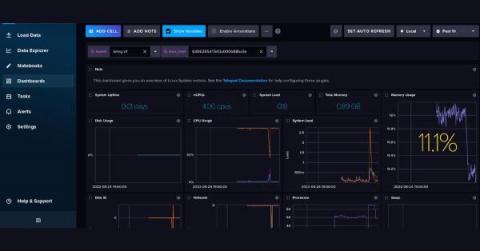
This article was originally published on HackMD and is reposted here with permission. Presently organizations are unable to monitor millions of embedded Linux devices in real-time. With so many different architectures and device types, aggregating telemetry and metrics and viewing that data in a centralized analysis tool is problematic. Onboarding embedded Linux devices into a telemetry service so that metrics can be easily observed is a significant challenge.
Ask any cloud software team using Kubernetes (and most do); this powerful container orchestration technology is transformative, yet often truly challenging. There’s no question that Kubernetes has become the de-facto infrastructure for nearly any organization these days seeking to achieve business agility, developer autonomy and an internal structure that supports both the scale and simplicity required to maintain a full CI/CD and DevOps approach.
Recently I joined a team to run a ‘Ragnar’. A ‘Ragnar’ is a running race where you and an additional seven teammates run a course that typically lasts around 24 hours non stop. Our team joined over 300 other teams running this Ragnar trail course in the middle of the woods in northern Wisconsin. This course consisted of three loops, a 3 mile loop, a six mile loop and a seven mile loop.
There are many computing resources used in different cloud application services to provide online software-as-a-service (SaaS). SaaS differs from traditional applications in that it works from a cloud computing environment. This means that both the application service as well as user data are being hosted by a cloud provider in the cloud. Therefore, the SaaS and data are accessible from anywhere as long as there's online access. This model provides a distinct advantage from a software perspective.