Operations | Monitoring | ITSM | DevOps | Cloud

Two years without cookies on the site, here's where we ended up

In January 2024, I wrote about removing all advertising cookies and user tracking from sentry.io. It was eight months into the decision at the time, and we were still figuring out what broke and what surprised us. That post struck a nerve: it became one of the most-read things we’ve ever published, probably because everyone building or running a product on the web was watching the same cookie deprecation timeline and wondering what would actually happen if someone just ripped the bandaid off.

N+1 Queries in Rails: A Guide to Detection and Prevention

N+1 queries are the most common performance problem in Rails applications. ActiveRecord’s lazy loading means every belongs_to, has_many, and has_one association is a potential N+1 waiting to happen. The good news is that Rails gives you multiple ways to fix them, and tools like Scout can find them automatically. This guide covers everything a Rails developer needs to know about N+1 queries: what they are, how to fix them, how to prevent them in CI, and how to detect them in production.

Azure Monitor Collector: Monitor Your Entire Azure Infrastructure From Netdata

If you’re running infrastructure on Azure, you’ve probably dealt with the split between your Azure-native monitoring and the rest of your stack. Your VMs, databases, and Kubernetes clusters generate platform metrics through Azure Monitor, but those metrics live in a separate world from the OS-level, application, and on-prem metrics you’re already watching in Netdata.

Not All Telemetry Requires Premium Pricing

Observability in software is often framed as a choice between self-hosted and SaaS: manage it yourself, or pay a vendor to handle your data. Both self-hosted and SaaS approaches have their merits, but assuming you must choose one exclusively over the other leads to poor trade-offs: either overcommitting to an all-in-one SaaS despite spiraling costs, or fully self-hosting when it’s unnecessary.

That's Not a Job for an LLM: The Right Way to Apply AI to Network Operations

LLMs have sucked all the oxygen out of the AI conversation — but AI is much more than just LLMs, and network engineers have been using AI techniques (machine learning, statistics, fuzzy logic, expert systems, neural networks) for decades. So what should LLMs be doing in network operations, what shouldn't they be doing, and how do agentic AI architectures fit in?

90% AI Adoption. Still Failing. DORA Explains Why.

AI adoption is nearly universal. So why are most teams still struggling? In this session from GitKon, Nathen Harvey, head of DORA at Google Cloud, shares findings from the 2025 DORA State of AI-Assisted Software Development report, drawing on data from nearly 5,000 developers worldwide. The answer isn't more AI. It's what surrounds it.

Do Hospitals Still Use Pagers in 2026? Why They're Not Secure (And What's Replacing Them)

Are hospitals still using pagers in 2026? The answer might surprise you. In this video, we break down why hospital pagers are still used today, the security risks of pagers, and whether they meet HIPAA compliance standards. While pagers have long been trusted for their reliability, many healthcare organizations are now re-evaluating their role in modern clinical communication. We also explore why pagers are considered insecure, including the lack of encryption, no read receipts, and limited communication capabilities, all of which can impact patient care and coordination.

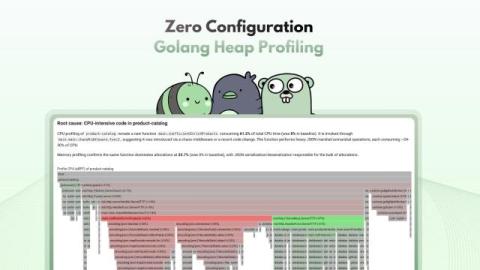
Zero-config Go heap profiling

Coroot's node-agent already collects CPU profiles for any process on the node using eBPF, with zero integration from the application side. For Java, we dynamically inject async-profiler into the JVM to get memory and lock profiles. But Go processes were still a blind spot for non-CPU profiling unless the app exposed a pprof endpoint and the cluster-agent scraped it. We wanted the same zero-config experience for Go heap profiles. This post is about how we got there.