Mailchimp
Not subscribed to OpsMatters Newsletter


Welcome to our blog, where we dive into the world of facilities management and explore the essential leadership skills that empower facilities managers to excel in their roles. Facilities managers play a crucial role in ensuring the smooth operation, maintenance, and optimization of physical spaces within organizations. Beyond their technical expertise, these professionals must possess strong leadership skills to effectively manage teams, oversee projects, and navigate complex challenges.
This post was written by Mercy Kibet, a full-stack developer with a knack for learning and writing about new and intriguing tech stacks. In today’s digital world, software applications are becoming increasingly complex and distributed, making it more challenging than ever to diagnose and troubleshoot issues when they arise.
Azure Blob Storage is a scalable, cost-effective, and durable cloud storage solution provided by Microsoft Azure. Serving as the backbone for many Azure services, it enables businesses to store a colossal amount of unstructured data ranging from documents, images, backup data, to log files, etc. Azure Blob Storage can handle all your static data that’s stored and read but not changed frequently, making it an indispensable part of any cloud data management strategy.
As the largest liquidity network in crypto, Paradigm facilitates more than $11 billion in monthly volumes, representing nearly 40% global cryptocurrency option flows. Their free-to-use platform provides a single point of access to multi-asset, multi-instrument liquidity on demand, and Software Architect Jameel Al-Aziz leads the team of developers who build and maintain the platform.
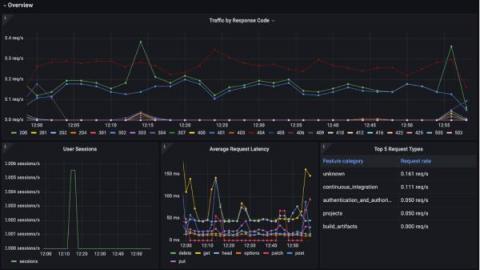
GitLab is a popular open source DevSecOps platform for software development. The Enterprise Edition is a web-based Git repository manager that allows teams to collaborate on code and automate workflows for building, testing, and deploying applications. We already offer the Gitlab datasource plugin, which allows you to query and visualize data from your GitLab instance on your Grafana dashboards.
By continuously monitoring network activity and assets, network monitoring plays a key role in identifying cybersecurity threats. The network monitoring process gathers important data that can be used in analytics or in conjunction with cybersecurity applications to rapidly identify and respond to threats.
Software-Defined Wide Area Network (SD-WAN) technology is revolutionizing the way organizations manage their network traffic. With its ability to decouple the data plane from the control plane, SD-WAN provides organizations with a more flexible, scalable, and cost-effective solution for managing their network traffic. However, understanding and troubleshooting SD-WAN performance can be a challenge, especially when it comes to the underlying physical network, or underlay.
Growth of cloud computing and the preference for data-driven decision-making have led to a steady increase in investments in observability over the years. Telemetry data is recognized as not only critical for maintaining a company’s infrastructure, but also for aiding security and business teams in making informed decisions. However, just increasing investment in observability technology is not enough.