Mailchimp
Not subscribed to OpsMatters Newsletter


We at Catchpoint are always striving to help our customers improve their products’ user experience, because, as we believe that “the experience is the point.” With a motto like that, you can bet we take the usability and effectiveness of our own platform very seriously, and are constantly striving to deliver a world-class user experience in the Catchpoint Portal. With that in mind, we have spent the better part of the last few years redesigning Catchpoint Portal from the ground up.
At Lightspeed, we maintain multiple large iOS projects as well as their modularized dependencies. The last year of acquisitions brought together many different approaches to CI/CD at our company. I recently led the initiative to bring these projects and practices into alignment. In this post, I will explain the goals we had for our continuous integration pipeline and the implementations we used to achieve them.
Android Manifest file is essential for any Android app, which contains specific information about your app, Android build tools, Google Play, device permissions, app launch information, operating system config and more. Every Android app must have an AndroidManifest.xml file in the directory structure. Android Manifest usually contains pre-defined or static information which is then used to run the app.
Atri Mandal, HEAL’s AI/ML expert, has written a second blog about the 4P strategy, this time primarily focusing on solution recommendation which gives useful suggestions to the SREs on how to fix problems pro-actively.
Network monitoring is a set of automatic processes that help to detect the status of each element of your network infrastructure. We are talking about routers, switches, access points, specific servers, intermediate network elements, and other related systems or applications (such as web servers, web applications, or database servers).In other words, network monitoring can be understood as taking a look at all the connected elements that are relevant to you or your organization.
Nowadays, microservice architecture is a pattern that helps to innovate quicker by enabling easier scalability, giving language flexibility, improving fault isolation, etc. Systems built this way also bring some downsides. Moving parts, concurrent invocations, and different retries policies can make operating and troubleshooting such systems challenging. Without proper tools, correlating logs with metrics may be difficult. To overcome these challenges, you need observability.
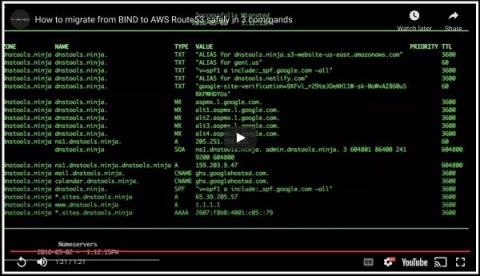
Migrating your DNS to a cloud provider like Amazon’s Route53 service can be a daunting task. Thankfully, with dns-tools you can test your DNS records before and after the migration to ensure that everything made it across in one-piece. This is the three steps we follow when migrating to Route 53: Follow along below and in just 10 minutes you’ll know if everything will migrate smoothly for you.