Mailchimp
Not subscribed to OpsMatters Newsletter


With the new normal adding several more challenges and variables to the security layer, how do you ensure your data is safeguarded without increasing the workload or the headcount of your security team? Using advanced analytics, in tandem with endpoint monitoring applications such as ManageEngine’s Mobile Device Manager Plus and Desktop Central, will help you better visualize and analyze your endpoint data, identify patterns, and establish correlations.
Apache Ignite is a computing platform for storing and processing large datasets in memory. Ignite can leverage hardware RAM as both a caching and storage layer to serve as a distributed, in-memory database or data grid. This allows Ignite to ingest and process complex datasets—such as those from real-time machine learning and analytics systems—in parallel and at faster speeds than traditional databases supported by only disk storage.
As healthcare and life sciences organizations move to digitize their operations and automate their workflows, they are encountering new challenges related to HIPAA regulations, which dictate how patient information should be collected and stored.
Metrics and logs have been around for a long time, yet we haven’t adopted common standards for them. Sure, there have been attempts on the metric side with OpenMetrics. Similarly, tracing only got a standardization effort with OpenTracing just a few years ago. There was no effort in a unified approach to standardize all observability signals until OpenTelemetry began a little less than two years ago. And there has been a need.
Uptime.com has been ranked #1 in Customer Support, and has been voted Most Likely to Recommend by the G2 Crowd Community. These terrific achievements cap off a year of activity and updates that have helped Uptime.com remain a market leader in IT alerting and web monitoring solutions. With top scores in IT Alerting and Web Monitoring, Uptime.com continues to grow alongside our userbase to create the most powerful and accessible web monitoring platform.
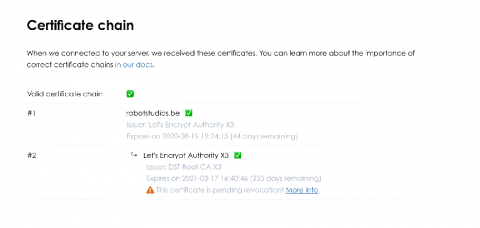
As part of our SSL certificate monitoring, we check a lot of things. The usuals, like if it covers the right domain name or if it hasn't expired are, of course, already included. But SSL certificates can get quite complex. Sometimes, SSL certificates get revoked by the issuer. When that happens, browsers worldwide stop trusting them and will throw an invalid certificate warning.