Mailchimp
Not subscribed to OpsMatters Newsletter


In a previous post we looked at 6 key considerations to keep in mind when selecting a log management solution: data collection, search experience, scalability, security, advanced analytics and cost effectiveness. Hopefully, you’ve managed to use this list to finally select your solution. What now?
In the words of the UFC's icon Bruce Buffer, with a 180 degree spinning announcement - "we...are...live..." and finally after a long beta period, we're ready to launch to the public as a whole. The beta period has been an excellent experience for us, and of course, a great learning curve.
When a visitor types your website into the search bar, they intend to see your website and not a broken link/webpage. In a digital world where we want everything right now, a website that is not available right now is a website we probably will not go back to in the future. That much should be obvious to everyone. If you are not careful, your website could be sending your visitors to your competitors. So how do you keep track of your website 24/7? One answer is to use an uptime monitoring service.
Docker 18.09 offers the possibility for a Docker client to communicate with a remote daemon via ssh. Here’s how.
The one complaint that an IT administrator dreads to receive is one where an end user says, “My application is slow!”. The application in question can be a web application, an enterprise application like SAP, Microsoft SharePoint, or a SaaS application like Salesforce or Office 365. Since the application is accessed over a network, it’s natural that the network team is pulled up first under the suspicion that it’s a network issue.
With AWS Lambda, we get blue-green deployment out of the box. After we update our code, requests against our function would be routed to the new version. The platform would then automatically dispose of all containers running the old code to free up resources.
If you’re trying to evaluate and understand the ROI of building an observability practice and carve out a budget for it, you’re not alone. You’ve probably got some monitoring and metrics capability already, but that’s proving to not be enough–how can you empower your teams as your environment becomes too complex for the basics? And how much will that cost?
Simple enough to be embedded in text as a sparkline, but able to speak volumes about your business, time series data is the basic input of Anodot’s automated anomaly detection system. This article begins our three-part series in which we take a closer look at the specific techniques Anodot uses to extract insights from your data.
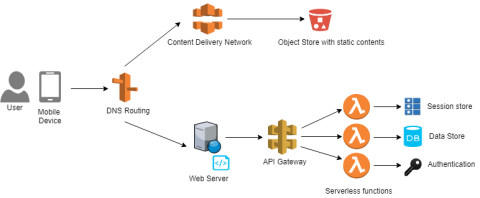
Serverless computing is a cloud-based application architecture where the application’s infrastructure and support services layer is completely abstracted from the software layer. Any computer program needs hardware to run on, so serverless applications are not really “serverless” - they do run on servers - it’s just that the servers are not exposed as physical or virtual machines to the developer running the code.
Businesses all over the world, especially small ones, always struggle with support software. With limited resources, it becomes difficult for them to manage different types of emails and they end up with more work than they can handle. The lack of proper support software has many negatives with companies not being able to cope up with the entire workload. This is one of the main reasons why there is so much demand for online tools like Groove.