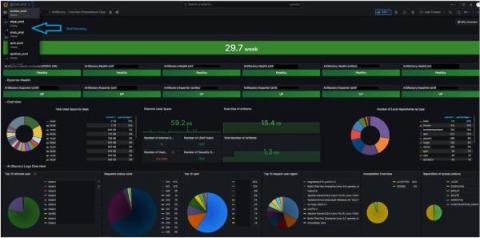
Observability-OSS vs Paid vs Managed OSS
The Reliability industry needs a managed, non-vendor lock-in answer to spiraling costs, high cardinality and the toil of managing a tsdb.
The latest News and Information on Databases and related technologies.
The Reliability industry needs a managed, non-vendor lock-in answer to spiraling costs, high cardinality and the toil of managing a tsdb.
So you want to spin up a Postgres database on your local machine, but you don't fancy having to install and manage everything manually? Running Postgres inside Docker is a great way to simplify the situation. It lets you: In this article I will explain how to do this step by step.
As the complexity of modern applications continues to increase, so too does the demand for comprehensive observability solutions. Organizations looking to enhance their applications’ performance, reliability, and scalability need powerful tools that allow them to monitor, analyze, and visualize their infrastructure. One such tool is InfluxDB 3.0, a time series database designed to handle large-scale monitoring and analytics workloads.
Even though SQL (Structured Query Language) has been around since the 1970s, it’s still a relevant and widely-used tool in today’s IT world. Many organizations around the globe still rely on SQL server databases to store their confidential data. In order to protect this valuable information, IT professionals often use differential backup to protect data in SQL servers. As you know, there are multiple types of backup available, so why use differential for SQL servers?
In the past few months, our team has worked hard to enhance our database features. We've made significant updates to our database management capabilities, giving our customers the ability to manage multiple logical databases on the same server (or cluster) and to create custom database users.
Databases power all modern applications. They’re behind your Angry Birds mobile game as much as they’re behind the space shuttle. In the beginning, databases were hosted on a single physical machine. Basically, it was a computer running only one program: the database. Then we moved to running databases on virtual machines, where resources are shared among multiple operating systems and applications.
Earlier this year, we experienced intermittent timeouts in our application while interacting with our database over a period of two weeks. Despite our best efforts, we couldn’t immediately identify a clear cause; there were no code changes that significantly altered our database usage, no sudden changes in traffic, and nothing alarming in our logs, traces, or dashboards. During that two-week period, we deployed 24 different performance and observability-focused changes to address the problem.