JFrog Pipelines - Overview: The Story, The Uniqueness, The Demo - Summer 2019
CPO Dror Bereznitzsky and former Shippable CEO Avi Cavale explore the story behind Pipelines and deliver an engaging demonstration.


The latest News and Information on DevOps, CI/CD, Automation and related technologies.
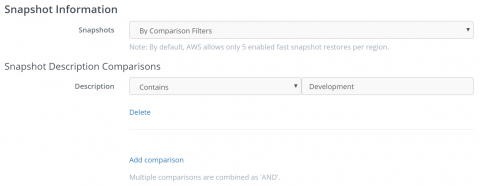
A month ago, Skeddly added a Disable EBS Fast Snapshot Restores action. This action is a fantastic way to ensure you don’t leave EBS snapshots around with Fast Snapshot Restores enabled. That will just be a waste of money. Today, I’m happy to announce a new Skeddly action: Enable EBS Fast Snapshot Restores. This new action allows you to enable, and optionally disable Fast Snapshot Restores on your EBS snapshots.
In Part 2, we showed you how to use Istio’s built-in features and integrations with third-party tools to visualize your service mesh, including the metrics that we introduced in Part 1. While Istio’s containerized architecture makes it straightforward to plug in different kinds of visualization software like Kiali and Grafana, you can get deeper visibility into your service mesh and reduce the time you spend troubleshooting by monitoring Istio with a single platform.
In Part 1, we showed you the metrics that can give you visibility into your Istio service mesh and Istio’s internal components. Observability is baked into Istio’s design—Mixer extracts attributes from traffic through the mesh, and uses these to collect the mesh-based metrics we introduced in Part 1. On top of that, each Istio component exposes metrics for its own internal workings.
Istio is an open source service mesh that was released in 2017 as a joint project from Google, IBM, and Lyft. By abstracting the network routes between services from your application logic, Istio allows you to manage your network architecture without altering your application code. Istio makes it easier to implement canary deployments, circuit breakers, load balancing, and other architectural changes, while also offering service discovery, built-in telemetry, and transport layer security.
DevOps teams are increasingly looking toward Kubernetes as a scalable and effective way to package application containers of all sorts.. However, while Docker and Kubernetes have paved the way for the container and microservices revolution, there is still plenty of room for innovation. The strength of the Kubernetes tool lies in its ability to blend the simplicity of Platform as a Service with the stability of Infrastructure as a Service software.
AWS (Amazon Web Services) is an amazing and reliable cloud service provider. AWS, like Google Cloud Platform and Microsoft Azure, provides everything you need to host an application without having to worry about running the underlying servers and network configuration. Everything you need to quickly begin hosting is provided as a packaged services.
Amazon recently announced the rollout of their new AWS Savings Plans, a new way to reduce your cloud compute costs. These allow you to achieve the discounts associated with their popular Reserved Instances (up to 72% off on-demand pricing) without having to engage in the headache of managing the same. With the new plans, you would commit to a particular hourly spend of your choosing on either a 1 year or 3 year fixed term.
Redis is an in-memory data store. It’s predominantly a key/value store, so it does not have features in many relational databases. It can be used as a simple database, a cache, or as a pub/sub system. Since it’s all in-memory, it is very fast, but it also requires alot of memory. Amazon Web Services, Microsoft Azure, and Google Cloud Platform all provide their own managed Redis services. The available versions and features vary from provider to provider. Let’s take a closer look.