Operations | Monitoring | ITSM | DevOps | Cloud

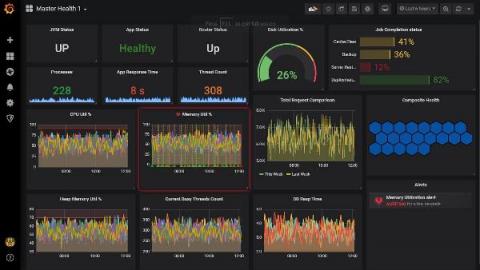
Best Grafana dashboard for IoT Device monitored via MQTT metrics and Graphite

Internet-of-Things (IoT) devices and technologies have penetrated into our life. Nowadays, we can easily find IoT devices around us. Home appliance manufacturers produce IoT products for smart homes. Car makers invest in smart vehicles that can communicate with other smart cars and IoT objects nearby. Governments allocate huge resources to build smart cities with IoT technologies to improve the quality of life for people and promote economic growth.
Challenges in Choosing an APM tool for Fintech Companies in India due to RBI Guidelines

As the growth lead of an open-source APM tool, I keep interacting with developers from companies of all shapes and sizes. I recently talked with a developer from a fintech startup in India. The startup provides a payment processing platform that enables businesses to accept payments from customers worldwide. For them, monitoring is critical, but the dev shared how limited they were when exploring an APM tool for their application. The reason? Reserve Bank of India.

Alternatives to Datadog

Before we dive into the specifics of each alternative to Datadog, let's address the most critical point: scaling. Datadog is great for users who need to do a little bit of everything, but Datadog's biggest weakness is scaling. Datadog can do logs, APM, time series and more, but scaling time-series metrics, alerts, and servers will cause your monthly bill to escalate. The graph below shows what you pay at Datadog vs. MetricFire, a leading competitor.

Learn how to monitor IoT devices with Grafana

IoT devices open the door to all sorts of computing potential, but they can also produce a flood of telemetry data that users need to properly collect and monitor to ensure those devices are working properly. It’s no wonder so many individuals and businesses use Grafana for IoT use cases, whether they’re starting an aquaponic farm in South Africa, managing an industrial-scale electroplating factory in Ohio, or simply keeping tabs on Pretzel the python at its home in the UK.

How Bhuma Achieved Testing Automation in No Time with Qovery

We talked with Juan Carlos, the Head of Software Architects at Bhuma, a software company that strives to be the go-to platform for frontend operational analytics. They provide businesses with cutting-edge tools to easily manage and visualize their data but when the team began to transition to EKS, they faced the challenge of automating testing and integration for containerized platforms. In this article, discover how Qovery helped Bhuma overcome this challenge effortlessly.

Improve engineering teams faster with DORA metrics

We talk with numerous teams that want to improve their engineering performance. Here, we explain how to accelerate your progress using DORA metrics — a set of key performance indicators that can help you measure and optimize your team's software development process. You'll learn practical tips on how to leverage these metrics to achieve faster and more efficient team improvement. But first, you'll need your team to see the value in DORA metrics.

Monitoring service performance: An overview of SLA calculation for Elastic Observability

Elastic Stack provides many valuable insights for different users. Developers are interested in low-level metrics and debugging information. SREs are interested in seeing everything at once and identifying where the root cause is. Managers want reports that tell them how good service performance is and if the service level agreement (SLA) is met. In this post, we’ll focus on the service perspective and provide an overview of calculating an SLA.

Multi-cloud trends in transport and logistics

The transport, logistics, and supply chain sectors are laser focused on efficiency. The aim is to get the right thing to the right place at the right time, making best use of the available infrastructure, while a multitude of global and local factors attempt to eat into margins. In the last 36 months, a litany of events have caused consistent supply chain issues, from Covid to grounded cargo ships, to industrial action to escalating fuel prices.

Profiling Using Java Agents

The core functionality of the Java Instrumentation API lies in its ability to modify the bytecode of classes being executed by the virtual machine. This capability allows for a range of monitoring tasks to be carried out, such as event recording and data gathering, which can provide valuable insights into an application's performance and behavior.

Enhancing Database Capabilities with Multi-Database and User Management

In the past few months, our team has worked hard to enhance our database features. We've made significant updates to our database management capabilities, giving our customers the ability to manage multiple logical databases on the same server (or cluster) and to create custom database users.