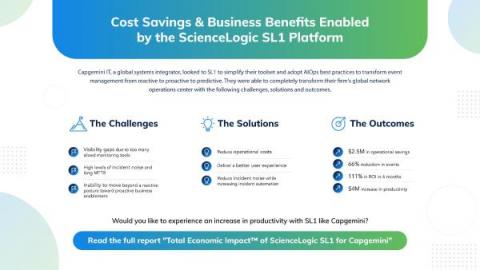
Cost Savings & Business Benefits Enabled by the ScienceLogic SL1 Platform
Capgemini IT, A global systems integrator, looked to SL1 to simplify their toolset and adopt AIOps best practices to transform their event management.


The latest News and Information on Monitoring for Websites, Applications, APIs, Infrastructure, and other technologies.
Capgemini IT, A global systems integrator, looked to SL1 to simplify their toolset and adopt AIOps best practices to transform their event management.
What if I told you one of the most common mistakes businesses make is reporting on website performance without understanding user experience? What if I said there was much more to website performance monitoring than simply alerting you when your site is experiencing a downtime outage? No two websites – or baselines – are exactly the same.
Securing an SAP environment is critical to any organization and as the use of public clouds grows for these environments, so does the concern of SAP security. These hyperscalers all have teams of people working around the clock to ensure their solutions are impenetrable. Third party cybersecurity solutions are often used as well to make sure these environments are safe and secure.
Network monitoring tools are an important part of any network management strategy since it gives you valuable information about network-related issues that could damage your business. Overloaded networks, router difficulties, downtime, cybercrime, and data loss are all dangers that can be mitigated by frequently monitoring networks.
Captchas are used on many websites to protect user accounts from bots and other automated programs, preventing them from accessing the website. According to Imperva's research, harmful bots generate 25.6% of all web traffic in 2020. They are used by spammers to send automated messages to users, and by hackers to attack websites with automated scripts that often wreak havoc on the site’s performance.
We’ve talked in previous posts about why we think the concept of exemplars are so valuable: They make it easy to jump from metrics into exactly the right traces, eliminating the needle in the haystack problem. We were enthusiastic enough about the idea that we helped contribute the necessary code changes to bring this functionality to the Prometheus ecosystem.
Business analytics and business continuity go hand in hand. Microsoft 365 as well as Azure services are used by companies around the globe to achieve better business outcomes. Learn why a hybrid approach to Azure and Microsoft 365 monitoring can be beneficial and what steps to take to get clear insights into SLA fulfillment.
According to ABC News, there has been a 600% rise in security intrusions during the COVID-19 pandemic, which is expected to double before 2025. In many circumstances, admins and technicians either intentionally or unintentionally play a part in the process of derailing the organization’s strategy for success. In order to prevent such mishaps, MSPs need a recovery plan to recuperate from any unfortunate accidents or cyberattacks.