
The latest News and Information on Distributed Tracing and related technologies.
Custom Metrics (JMX, Golang expvar, Prometheus, statsd or many other), APM and Opentracing are different approaches on how to instrument code in order to monitor health, performance and troubleshoot your application more easily.
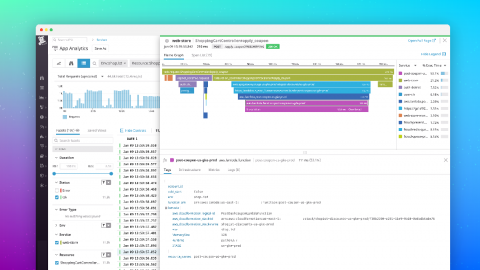
Since we made Datadog APM generally available last year, we have continually added new features and support for new languages and frameworks to ensure that you can monitor every aspect of application performance. Datadog APM helps companies such as Airbnb, Square, and Zendesk to optimize application performance and deliver top-notch customer experiences.
Here at the Hive, we know that there’s nothing like getting your hands on something to see what using it to solve a problem is really like. In July, we launched the Gatekeeper tour, which walks you through the process of solving a real outage we experienced, using Honeycomb. That’s why we’re excited to launch a new place for you to play: the Tracing Tour at http://play.honeycomb.io.
Tracing bugs in your PHP code can be very time-consuming. In order to find bugs quickly in your PHP applications, you can use PHP tracing tools. Stackify provides two tools, Retrace & Prefix, which can help with tracing what happens within a web request or transaction.
Node.js is an asynchronous JavaScript runtime that is used to develop highly scalable network applications. To help provide more visibility into these dynamic environments, we’re pleased to announce that Datadog APM has officially released support for monitoring Node.js applications, which joins our existing support for Java, Ruby, Python and Go.
Request tracing is the ultimate insight tool. Request tracing tracks operations inside and across different systems. Practically speaking, this allows engineers to see the how long an operation took in a web server, database, application code, or entirely different systems, all presented along a timeline. Request tracing is especially valuable in distributed systems where a single transaction (such as “create an account”) spans multiple systems.