Operations | Monitoring | ITSM | DevOps | Cloud

The State of DCIM Software in 2026

Data Center Infrastructure Management (DCIM) software has matured considerably over the past decade. Deployments are faster, interfaces are easier to use, integrations are deeper, and organizations across industries are seeing real, measurable results. According to Gartner, DCIM software has reached a critical inflection point in the Hype Cycle: the Plateau of Productivity.

Inside the .de DNS Outage: Real-World Data from UptimeRobot.

In the evening of May 5th, 2026, large parts of the German web briefly went dark. For a few hours, anyone trying to load a.de address through a major DNS resolver got errors instead of websites. Bahn.de, Amazon.de, and Spiegel.de were among the affected. Major brands like Telekom, DHL, and Sparkassen felt it too, along with hosting providers Hetzner, Strato, and Ionos.

Resolve's Agents of IT - S2Ep9 - When AI Personalization Gets too Personal

In this episode of Agents of IT, we dive into one of the biggest conversations shaping enterprise AI right now: personalization. From copilots vs autonomous agents to the “creepiness threshold” of hyper-personalized AI, we explore what organizations are getting right, what they’re getting wrong, and why context matters more than ever in the future of IT operations. Topics covered in this episode: The team also breaks down.

Navigating the Middleware Maze: How meshIQ 12.1 Redefines Scale and Simplicity with Agentic AI

meshIQ v12.1 transforms middleware management with petabyte-scale data processing and agentic AI. The new intelligent launchpad, simplified onboarding, and context-aware safeguards move teams from reactive monitoring to proactive, AI-driven operations across the enterprise.

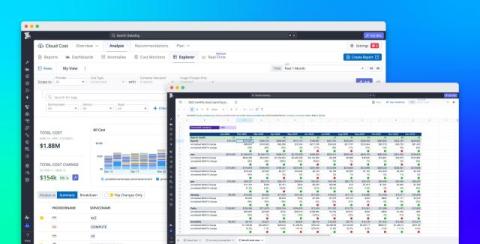
Analyze cloud costs with flexible spreadsheets in Datadog Sheets

Cloud cost data is most useful when teams can adapt it to their own reporting and planning needs. In addition to viewing cost breakdowns, FinOps teams often need to calculate forecasts, reshape datasets, and present tailored views to finance and leadership teams. In many workflows, those steps happen outside the observability platform. Once the data is exported, it quickly becomes outdated and requires repeated manual updates.

Datadog for Government achieves FedRAMP High certification

Modern government missions depend on software platforms that can perform under demanding conditions. As agencies update systems that support public safety, benefits delivery, financial operations, and national priorities, they face security and compliance requirements that shape how technology is adopted as well as how it is built, operated, and evolved over time.

How to reduce alert noise without missing what matters

Reducing alert noise involves drawing a line between incidents that need an immediate response and ones that do not. Get this distinction wrong and your team is either interrupted unnecessarily or misses something critical. In this guide, we’ll help you make that distinction clear. We’ll cover what counts as noise and how to reduce it without missing what matters.

Elasticsearch 9.4 powers the next phase of the Elastic AI Ecosystem: Dell AI Data Platform with NVIDIA

AI is moving fast. Enterprise adoption needs to move with purpose. Over the past year, one thing has become clear: Organizations are not looking for more AI hype. They are looking for a path to production — one that connects infrastructure, data, and intelligence in a way that delivers real business value. That is exactly what the Elastic AI Ecosystem is built to do. At Elastic, we believe AI is only as powerful as the data foundation behind it. Great models matter.

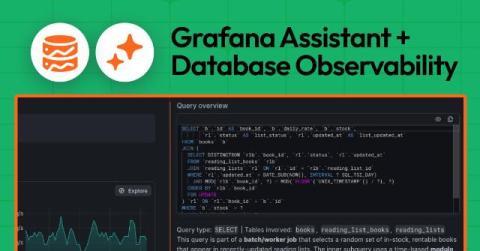
Troubleshoot performance issues faster with the new Grafana Assistant integration for Database Observability

So your database is slow. Now what? Grafana Cloud Database Observability already gives you visibility into your SQL queries with RED metrics, individual execution samples, wait event breakdowns, table schemas, and visual explain plans. But visibility is just the starting point. You can see that a query's P99 latency spiked, but what should you do about it? You can see wait events like wait/synch/mutex/innodb firing, but what does that actually mean?