Operations | Monitoring | ITSM | DevOps | Cloud

AI SAST Explained: Why Traditional Application Security Is Reaching Its Breaking Point | Harness Blog

AI has fundamentally changed software development. Developers are writing more code than ever. AI coding assistants can generate features, tests, documentation, and infrastructure configurations in minutes. Engineering organizations are seeing meaningful productivity gains as AI becomes embedded throughout the software development lifecycle. But there is a catch. Security teams now face a difficult reality: application security was already struggling to keep pace with software delivery before AI arrived.

Just ask AI to add OpenTelemetry to your code

OpenTelemetry instrumentation used to mean hours of manual work, wiring up metrics service by service. Now you can just ask for it. Tell an AI agent what you're trying to observe, something like "add OpenTelemetry so I can track this application's performance," and it turns that into an intent specification, then enriches your existing code with instrumentation to match. OpenTelemetry is open source and on GitHub. Pairing it with an AI agent that actually understands your codebase is what turns "add some metrics" into instrumentation that's useful.

Cut AI coding defects by 33% #mcpserver #aicoding #aiagents #grafana #aitools

We spend thousands of dollars "token maxing" and running endless debugging cycles just to walk our LLMs through a problem. But is the AI actually failing, or are we just withholding the right environment? Giving your AI assistant its own sandbox to test hypotheses might just be the missing link in your development workflow.

How the UK Conveyancing Process Can Be Automated and Streamlined Using Digital Tools

Buying or selling a home has historically been a waiting game filled with massive paper trails, slow posts, and constant phone chasing. Fortunately, the UK property market is undergoing a significant shift as innovative digital tools replace archaic workflows.

Enterprise AI isn't broken; your data is broken

A friend who runs data engineering at a mid-sized logistics company once showed me something that made me laugh, and then made me a little sad. Her team spent four months building a chatbot that was supposed to answer simple questions like "how many shipments are delayed in the Chennai warehouse right now." The bot worked beautifully in the demo. Then someone asked it a real question, and it confidently returned a number that was off by almost a factor of ten. Not because the model was dumb.

Agent security starts with where the agent runs, not how it behaves

When engineering teams evaluate AI agents, the first questions are usually about capability. Which model performs best? How much faster can it write code? What's the return on investment? Security, if it enters the conversation at all, tends to come later. Patrick Dawkins, Principal Software Engineer at Upsun, thinks that's backward. Over the past year, he's been building the infrastructure that enables AI agents to operate safely within engineering teams.

Railway Mania, the birth of the S&P 500, and the lesson for the AI era

In 1846, Britain poured roughly 7% of its national income into railways, proportionally about three times what the U.S. spends on AI infrastructure today. The technology delivered everything it promised, and a generation of investors still lost their shirts. What sorted the winners from the wreckage wasn't conviction about the technology; it was whether ROI was measured or asserted. The man who fixed that problem gave his name to the S&P 500.

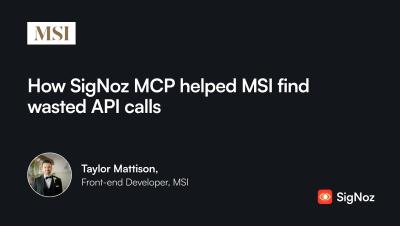
How SigNoz MCP Helped MSI Find 20 Unnecessary Operations

Taylor Mattison explains how SigNoz MCP helped surface wasted work inside MSI's sales-order workflow. Warning checks were firing on user actions that had nothing to do with any warning they could raise. By comparing telemetry across the workflow, Taylor could point to unnecessary operations that were wasting API calls, database time, and server capacity. This clip is part of our MSI customer story on using SigNoz MCP with Claude to debug slow sales orders across the stack.