Operations | Monitoring | ITSM | DevOps | Cloud

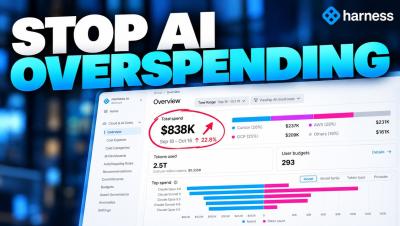
Harness Cost Management Agent | How to Set and Enforce AI Spending Budgets

Control AI spending across your organization with Harness Cost Management Agent's AI User Budgets. In this demo, see how Harness helps teams set, monitor, and enforce AI spending limits across tools like Claude, Cursor, and Amazon Bedrock, all from one centralized control plane. What you'll learn: Set weekly AI spending budgets for users and teams Track AI consumption across multiple tools and models.

Modal scales the next generation of AI with unified observability from Datadog

Modal is an AI infrastructure company rebuilding the cloud for AI, giving developers easy access to the compute needed to build and scale AI applications without managing the underlying complexity. Operating across more than 20 cloud providers and launching approximately 26 million containers daily, Modal relies on Datadog to unify observability across its infrastructure, applications, networking, and CI—helping its engineers detect 99% of incidents within five minutes, resolve 96% of issues before customer impact, and confidently scale one of the world’s most complex AI platforms.

AI inference, explained through one question

TL;DR Part 0 of a three-part series on building a documentation assistant with Aiven. This part gives you the vocabulary. Part 1 is the architecture. Part 2 builds the thing. Almost everything written about large language models explains how models get built. Very little explains what happens the other billion times, when a finished model sits there answering questions. That second thing is called inference, and it is where practically all of the engineering work actually lives.

MCP Server Monitoring: Tracing Tool Calls with OpenTelemetry

MCP server monitoring guide: spans, metrics and logs to record for tool calls, why failed tools look healthy, and how to trace requests from client to server. Sejal Pandey works on content and growth at Last9, writing about observability, reliability, and SRE practices.

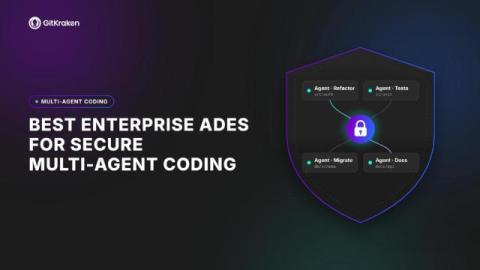
7 Best Enterprise ADEs for Secure Multi-Agent Coding (2026)

Your engineering team runs five AI coding agents across three repositories. One is stuck waiting for input, another just overwrote a file the third one was editing, and nobody knows which branch belongs to which task. Sound familiar? Agentic development environments solve this coordination problem by giving you a single surface to orchestrate, review, and merge agent-driven work. This guide compares seven enterprise-ready ADEs built for secure, multi-agent coding workflows.
Featured Post

AI Is Making Infrastructure Easier to Create and Harder to Operate

AI is rapidly changing the economics of software engineering. Tasks that once required hours of engineering effort can increasingly be completed in minutes. An AI agent can write an application, generate Terraform, produce Kubernetes manifests, configure a CI/CD pipeline, and interact directly with cloud APIs. For infrastructure teams, this sounds like an enormous productivity win. And on Day 1, it is. But generating infrastructure has never been the hardest part of running it.

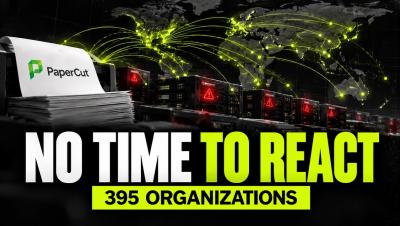
AI Agents Hacked 395 Organizations. How Do You Stop Them?

AI agents just changed the speed of cyberattacks. Are security teams ready? In a massive AI-orchestrated cyberattack, hundreds of autonomous AI agents exploited vulnerabilities in PaperCut software, compromising 440 servers across 395 organizations in 48 countries. But the bigger question isn't how these attacks happened. It's how human security teams are supposed to respond when attacks move faster than they can react.

The Growing Divide Between Digital Simplicity and Real-World Complexity

A banking app can approve a transaction in seconds. An AI assistant can produce a detailed report from a single instruction. Yet correcting a banking error or verifying an AI-generated report can take hours. This contradiction is becoming more visible as digital services grow easier to operate. Interfaces require fewer steps, but the processes behind them involve increasingly complicated systems, decisions, and responsibilities. The question is whether technology is eliminating complexity or simply moving it somewhere users cannot see.

How CFOs can control AI spend and prove AI's value

Neil Sawyer, Senior Vice President and Managing Director for HP Europe, Middle East and Africa, recently published “Scaling AI Without Losing Control” in Forbes Business Council. His starting point will be familiar to any finance leader. AI pilots looked affordable on pay-per-token and pay-per-query pricing, and that same pricing can get far more expensive at enterprise scale. Gartner forecasts worldwide AI spending will reach $2.7 trillion in 2026, up 49.5%.

AI infrastructure costs in 2026: what the stack is, what each layer costs, and how much to commit

AI infrastructure costs span four buying tiers in 2026: API-only teams spend hundreds to tens of thousands per month on tokens, GPU renters typically pay $2 to $10 per GPU-hour by chip class, committed-capacity buyers sign six-to-eight-figure reservation contracts, and owners spend millions per rack. The stack has six layers, and most budgets underestimate everything below the GPU line.