Operations | Monitoring | ITSM | DevOps | Cloud

The latest News and Information on Monitoring for Websites, Applications, APIs, Infrastructure, and other technologies.

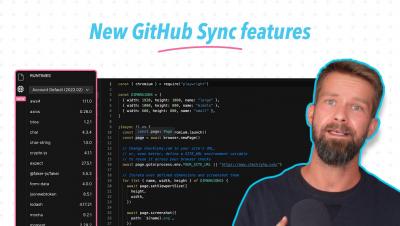
How to globally monitor your edge functions using Checkly

If you're leveraging an Edge geolocation feature and serve different behavior depending on the request origin, you want to guarantee your application doesn't break for some users over time. Learn how to use Checkly to monitor and test your Vercel Edge functions from different global locations and get alerted when your Edge handling broke. Resources.

Prime Day's High Traffic Survival Guide

Did you, along with billions of others around the world, snag some deals yesterday at the start of Amazon’s Prime Day 2022? It's no secret that July 12-13th marks Amazon’s two-day online shopping event. There are no hard stats yet on this year's numbers, but according to Influencer Marketing Hub, the world’s largest online retailer generated record sales of about $11.2 billion during their 2021 Prime Day, a 7.6% increase from 2020.

The Leading Tools Compatible With OpenTelemetry

OpenTelemetry (also known as OTel) is a popular open-source framework used to generate telemetry data for traces, metrics, events and logs. In this guide, we are going to cover the best observability and application performance management tools that can be used alongside OpenTelemetry to transform telemetry data into responsive reporting dashboards.

Application Performance Monitoring Needs a Makeover With Digital Experience Monitoring

Virtual collaboration is the new name of the business game in 2022, with at least 25% of employees in the US predicted to be working remotely by the end of the year. As the Work-from-anywhere movement continues to grow and online meetings become the industry standard, remote employees increasingly rely on access to SaaS and mission-critical services directly from the Internet.

Analyzing Test Results Through Your Logs & How to Choose Which Automation Tests to Implement

According to the 2021 test automation report, more than 40% of companies want to expand and invest their resources in test automation. While this doesn’t mean manual testing is going away, there is an increased interest in automation from an ROI perspective – both in terms of money and time. After all, we can agree that writing and running those unit test cases are boring.

Introducing Splunk Attack Range v2.0

The Splunk Threat Research Team (STRT) has continued focusing development on the Splunk Attack Range project and is thrilled to announce its v2.0 release with a host of new features. Since the v1.0 release 6 months ago the team has been focused on developments to make the attack range a more fully-featured development testbed out of the box. This blog post will share these additions as well as some of the project’s future directions.

State of Kubernetes 2022: Report Roundup

According to recent surveys and reports on the industry, Kubernetes and containers are more popular than ever. Containers and serverless functions are being mainstream and ubiquitous – with a more than 300% increase in container production usage in the past 5 years. This trend is especially true for large organizations, which are often using managed platforms and services.

Network Performance Monitoring vs. Application Performance Monitoring: What's The Difference?

Network performance monitoring (NPM) and application performance monitoring (APM) are both key pillars of an overall performance and reliability management strategy, especially when dealing with complex, distributed infrastructure across cloud-native environments. NPM and APM also complement each other, in the sense that NPM can serve as an additional source of truth and observability for application performance.

Common Anomaly Detection Challenges & How To Solve Them

Anomaly detection can be defined by data points or events that deviate away from its normal behavior. If you think of this in the context of time-series continuous datasets, the normal or expected value is going to be the baseline, and the limits around it represent the tolerance associated with the variance. If a new value deviates above or below these limits, then that data point can be considered anomalous.