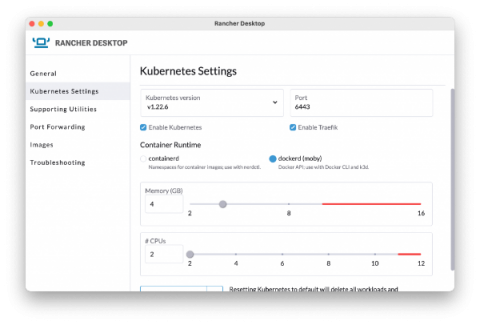
Rancher Desktop: Now You Can Disable Kubernetes
With the 1.1.0 release of Rancher Desktop, there are some changes that give you more control over your environment.


The latest News and Information on Containers, Kubernetes, Docker and related technologies.
With the 1.1.0 release of Rancher Desktop, there are some changes that give you more control over your environment.
Shipa Cloud is how we run the Shipa control plane on behalf of users in order to give them the fastest path possible to implementing Application as Code within their clusters. You can try out Shipa Cloud for free today by going to shipa.io. Besides being the fastest way possible to get started with Shipa, it also takes away the responsibility of upgrades, maintenance, and uptime of the control plane for our users, but that responsibility doesn’t just disappear.
Containerisation has transformed the enterprise IT landscape, driving faster, more secure, and more predictable software delivery than ever before. Thanks to technologies like Docker, building containerised applications is easy, and many businesses are working with hundreds or even thousands of containers. To effectively deploy and manage all of these microservices, a container orchestration tool is essential, and Kubernetes is the leading solution.
This article was inspired by our recent "5 tools to increase Kubernetes developer productivity" video, hosted by Saiyam Pathak and Kunal Kushwaha. Over the years Kubernetes has become the de facto orchestration platform, as such it's crucial that developers have the right set of tools to increase their productivity for development and operations. In this article, we take a look at five such tools that can help developers inprove productivity while when Kubernetes. Let’s jump in.
Continuing on from Part One where we went through a brief history of containers and Kubernetes then Dockerized a NodeJS application, now we are ready to deploy to Kubernetes. If this is your first or nth time deploying to Kubernetes, Shipa makes this simple. You don’t have to worry about authoring multiple Kubernetes manifests and templates to deploy your application, all you need is an image.
KoolKits (Kubernetes toolkits) are highly-opinionated, language-specific, batteries-included debug container images for Kubernetes. In practice, they’re what you would’ve installed on your production pods if you were stuck during a tough debug session in an unfamiliar shell. To briefly give some background, note that these container images are intended for use with the new kubectl debug feature, which spins up Ephemeral containers for interactive troubleshooting.