Operations | Monitoring | ITSM | DevOps | Cloud

The latest News and Information on Incident Management, On-Call, Incident Response and related technologies.

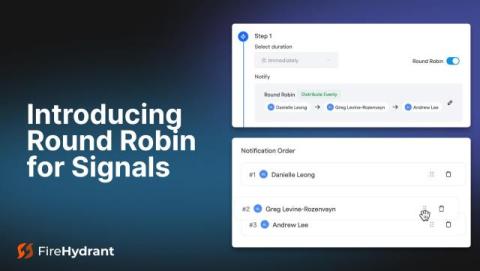
Introducing Round Robin for Signals Escalation Policies: More Flexibility, Control, and Balance

At FireHydrant, we know that alert management is about more than just getting notifications to the right people — it’s about reducing stress and fatigue, balancing workloads, and empowering your team to respond with confidence. That’s why we’re excited to unveil Round Robin for Signals Escalation Policies, a feature designed to make alert escalations smarter, fairer, and more team-friendly by allowing you to automate the sequential assignment of new alerts.

Automate Fast & Win: 11 Event-Driven Automation Tasks for Enterprise DevOps Teams

Event-driven automation is a powerful approach to managing enterprise IT environments, allowing systems to automatically react to enterprise events (Observability / Monitoring / Security / Social / Machine) and reducing or removing the need for manual intervention. This post discusses 11 common automation tasks that are ideal for enterprise DevOps teams looking to enhance operational efficiency, reduce downtime, and ensure business continuity. Struggling with ideas for where to start?

AIOps for DevOps: Enhancing Collaboration and Efficiency

More than ever, DevOps teams are constantly tasked with improving collaboration, accelerating software development, and ensuring smooth operations. However, traditional monitoring and alerting methods, often called a “black box approach,” offer limited insight into system performance. As a result, teams rely on reactive approaches, only responding to incidents after they occur without prior planning or strategy.

How To Decide Between Hosting Your Own Status Page Versus Using a Managed One

A status page forms a key part of your incident communication strategy. When it comes to setting up a status page, you have two options: We will examine the pros and cons of each option along these dimensions: For 1, if you choose a self-managed, open-source or custom solution, it's in your control. For a managed solution, you are limited by the provider's feature set. For 2, if you choose a self-managed solution, your team is responsible for the quality of the service.

2024 year in review with the incident.io founders

In this episode, we take a look back at 2024 at @incident-io — reflecting on the year’s personal milestones, company-wide changes, and how our product has evolved along the way. Of course, no reflection would be complete without a healthy dose of "banter". Join us as we wrap up the year with insights, laughs, and a lookahead to what's coming early 2025.

The Incident Maturity Model

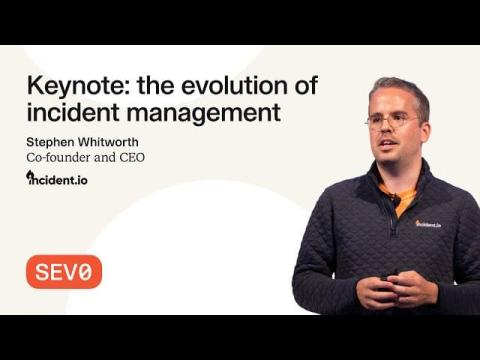
I want to walk you through how incident management has evolved, drawing from real data and the experiences of some of the most sophisticated tech organizations out there. I'll also introduce you to a framework we’ve developed at incident.io: the Incident Maturity Model. This framework is the result of thousands of conversations with companies and provides a clear roadmap to help your organization improve its incident management practices—no matter where you're starting from.